Recent Gallery


Tampilkan postingan dengan label Monuments. Tampilkan semua postingan

The Megaliths of Great Britain

A megalithic monument, in archaeology, is a construction involving one or several roughly hewn stone slabs of great size; it is usually of prehistoric antiquity. These monuments are found in various parts of the world, but the best known and most numerous are concentrated in Western Europe, including Brittany, the British Isles, Iberia, South France, South Scandinavia, and North Germany, the highest concentration being at Great Britain. Scotland, England, Ireland and Wales together accounts for hundreds of megalith and stone circle sites.

Here is a collection of some of the more popular ones.
stonehenge
The most famous megalith structure is the world is the Stonehenge in the English county of Wiltshire. Stonehenge is composed of earthworks surrounding a circular setting of large standing stones. It is at the centre of the most dense complex of Neolithic and Bronze Age monuments in England, including several hundred burial mounds.

Stonehenge2
Archaeologists had believed that the iconic stone monument was erected around 2500 BC. One recent theory, however, has suggested that the first stones were not erected until 2400-2200 BC, whilst another suggests that bluestones may have been erected at the site as early as 3000 BC. While the age of the structure is subject to debate, there is little doubt about its purpose. Evidences indicate that Stonehenge served as a burial ground from its earliest beginnings. The dating of cremated remains found on the site indicate burials from as early as 3000 BC, when the initial ditch and bank were first dug. Burials continued at Stonehenge for at least another 500 years.
1
The Mên-an-Tol (also written as Men an Toll) is a small formation of standing stones near the Madron-Morvah road in Cornwall, United Kingdom. It consists of three upright granite stones: a round stone with its middle holed out with two small standing stones to each side, in front of and behind the hole. These stones might have been the entrance to some now vanished tomb. It is possible that they were part of some ancient calendar.
Menantol
Mên-an-Tol is supposed to have a fairy or piskie guardian who can make miraculous cures. Local legend claims that if at full moon a woman passes through the holed stone seven times backwards, she will soon become pregnant. Another legend is that passage through the stone will cure a child of rickets. For centuries, children with rickets were passed naked through the hole in the middle stone nine times.
4
Castlerigg Stone Circle stands one mile to the east of Keswick and was built around 3000 BC. It is set on a low hill with magnificent views of the mountains of Skiddaw and Blencathra.
5
One of Dartmoor's most enigmatic features are the standing stones which sit on the remote hilltops surveying the centuries as they speed by. The sad fact is that in the whole of the Dartmoor National park there are only 12 which are left intact and stand on the open moor.
6
Orkney Islands is littered with stone structures. The Ring o' Brodgar is the most famous among them.
7
One of the most famous circles in the British Isles, Rollright in Oxfordshire consists of 77 stones. According to a legend, the Rollright Stones were once human beings: the army of a King whose story is explained in the King Stone page. There are other legends, though; one is that the King's Men are uncountable. A baker who tried to ascertain their number by placing a loaf on top of every stone was not successful, because he did not have enough loaves. Another story tells that at midnight on New Year's Day the stones go downhill to drink at a spring in Little Rollright spinney.
8
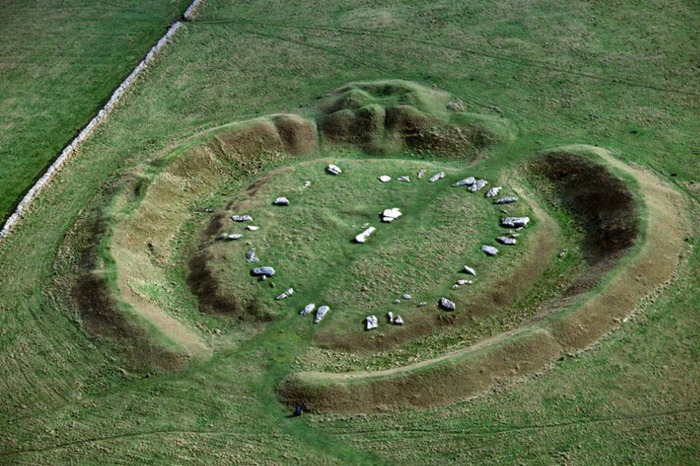
Arbor Low, in the Peak District, Derbyshire, England, consists of about 50 large limestone blocks, quarried from a local site, which form an egg-shaped circle, with monoliths at the entrances, and possibly a portal stone at the south entrance.
Callanish-circle
The Callanish Stones are situated near the village of Callanish on the west coast of the isle of Lewis, in the Outer Hebrides, Scotland. Situated on a natural ridge that has a north-south orientation, the Callanish monument consists of a central circle of 13 stones from which four alignments extend to form a general cross shape. The northern alignment is longer than the rest and a double rows, forming an avenue.

More pictures of megalith sites an be seen at Megalithics.com

The Statue of Liberty | Under Construction Remarkable Photographs

The New York Public Library has recently unveiled some extraordinary pictures of the Statue of Liberty under construction. Take a trip back in time and see extraordinary behind the scenes images of the creation of this superlative structure.

The Statue of Liberty | Under Construction Remarkable Photographs

A giant is formed. The sheer scale of the statue under construction can be seen here, in contrast to the workmen posing woodenly for that fairly new invention, the camera.. The more formal name for the statue is Liberty Enlightening the World and it is constructed with sheets of pure copper, even though the picture makes it look something like marble.. It is something of a miracle that we now have the finished product standing proudly on Liberty Island. Had it not been for the contributions of ordinary French and Americans then she would never have arisen in the first instance.

The Statue of Liberty | Under Construction Remarkable Photographs

Such is the immensity of the statue one can only wonder whether or not the workmen pictured above had any idea which part of the statue they were working on at any one time. The photographer Albert Fernique, who captured these pictures around 1883, must have been in a certain awe at the immensity of the statue and his images capture its sheer scale and size beautifully. The French had decided to give the United States of America something for their centennial independence celebrations that the Americans and the world would never forget. The process of building was painstaking, slow and fraught with financial difficulties. The copper ?shell' was only what the public would see. What lies beneath - both in terms of its structure and the story behind its *****ion - is almost as startling

The Statue of Liberty | Under Construction Remarkable Photographs

Officials survey the workshop - models of statues can just be seen in the background. While they probably had an idea that their statue would become an icon of freedom the world over, the French politicians of the day had some rather more down to earth reasons for gifting the immense sculpture to the States. French politics. Perhaps for this reason the source of the copper has never been revealed. The rumor had always been that the copper was of Norwegian origin, from a village called Visnes, rather than a French source. In 1985 Bell Labs confirmed that this was fairly likely to be true.

The Statue of Liberty | Under Construction Remarkable Photographs

At the time France was in political turmoil and, although at the time under their third republic, many people looked back at the time of Napoleon and the monarchy before that with fondness and wanted its return. The desire for a backwards step to authoritarianism was worrying. French politicians - as wily then as now - saw Lady Liberty as a way, albeit phenomenally huge, to focus the public's imagination on republicanism as the best way forward. The USA and its centennial of independence from the yolk of England was the perfect focus.

The Statue of Liberty | Under Construction Remarkable Photographs

The plaster surface of the left arm and its hand take shape, the skeleton underneath revealed. As there is a deal of work under the carapace, so the French politicians had ulterior motives. Using the USA - which many saw as the ideal of government and populist aspirational politics - the French used the statue as a Trojan Horse in reverse, as it were. Its true purpose, in the eyes of the political gift givers, was to make republicanism the center of political ideology in the minds of the people. How greatly it succeeded can never fully be quantified but the French cannot be faulted for thinking big. It must be said here that the ordinary French, through their substantial buying of lottery tickets (and other fundraising efforts) had a much purer purpose at heart than their politicians.

The Statue of Liberty | Under Construction Remarkable Photographs

It must surely have been amazing for the workers to turn up each morning to the sight of a colossal head looking down upon them. The inspiration for the face seems to be the Roman god of the sun, Apollo or his Greek equivalent, Helios. More down to earth sources of inspiration center on the women in the life of the sculptor, Frederic Auguste Bartholdi. It may well have been Isabella Eugenie Boyer, a good looking and well-known figure in Paris at the time. More worrying, some believe the face of the statue actually belongs to Bartholdi's mother. Bartholdi never revealed the true model of the face, but if this is the case Freud would have had a field day.

The Statue of Liberty | Under Construction Remarkable Photographs

Bertholdi made a small scale model first, which is still displayed in the Jardin du Luxembourg in the city of the statue's original construction, Paris. Before the statue was shipped to America, though, it had to be seen to be tested. If it had not been for money, it may never have landed in the states - particularly in the form we all know. On a visit to Egypt, Bartholdi's vision of liberty expanded to its present proportions. Had his original idea received financial support, then whatever gift the French gave the Americans for the 1876 centennial could not possibly have been the statue.

The Statue of Liberty | Under Construction Remarkable Photographs

Little by little, the statue arises. Bertholdi saw the Suez Canal under construction in the eighteen sixties and was inspired to build a giant figure at its entrance. He drew up plans which bore a remarkable similarity to what now stands on Liberty Island but his ideas were rejected by the Egyptian ruling body of the time because of the financial problems the country was facing at the time. Had the statue been built in Egypt as a lighthouse, the idea would never have been taken up for America. The Statue of Liberty as we know it was in fact used as a lighthouse, from its unveiling in 1886 right until 1902 - the very first in the world to use electricity.

The Statue of Liberty | Under Construction Remarkable Photographs

Almost there! There were huge structural issues that had to be addressed in the design and construction of a sculpture of such enormity. Enter a certain Gustave Eiffel, who would later go on to build that eponymous tower which still dominates the skyline of Paris. It was his job (which he delegated to Maurice Koechlin, his favored structural engineer) to ensure that Liberty's copper sheath could move while still remaining vertical. Koechlin created a huge pylon of wrought iron and the famous skeletal frame to ensure that the statue would not fall down in high winds.

The Statue of Liberty | Under Construction Remarkable Photographs

Money was always a problem. The plan had been to get the statue to the US by the fourth of July, 1876. Only the right arm and torch were finished by then. However, as the Americans had taken responsibility for the construction of the pedestal, these pieces of the statue were displayed to the American pubic at the Centennial Exposition (in Philadelphia). Money raised by allowing people to climb this part of the statue (see here) started the funding efforts for the base of the statue. The French did their bit too, showing the head in their own exposition in 1878.

1886 must have been one of those years that people remembered for the rest of their lives. A statue of gigantic proportions, symbolizing the ideas and aspirations of America, was unveiled by President Grover Cleveland at Liberty Island (renamed from Bedloe's Island or Love Island). In an ironic twist, President Cleveland had vetoed the New York legislature from contributing fifty thousand dollars to help with the building of the statue's pedestal. Letting bygones be bygones, President Cleveland was more than happy to officiate at the ceremony. This had not been the only problem to face the statue in the years before its final unveiling, of course. From the model stage, above, to its triumphant moment of revelation, the process was fraught with difficulty - mostly of a financial nature. However, thanks to the efforts of both the American and French people we now have a permanent reminder of what we should hold dear - liberty still symbolically steps forth from her shackles to protect, shelter and enlighten.

Mount Rushmore and Flag Row

By Uncletom2007

Originally known to the Lakota Sioux as Six Grandfathers, the mountain was renamed after Charles E. Rushmore, a prominent New York lawyer, during an expedition in 1885. At first, the project of carving Rushmore was undertaken to increase tourism in the Black Hills region of South Dakota. After long negotiations involving a Congressional delegation and President Calvin Coolidge, the project received Congressional approval. The carving started in 1927, and ended in 1941 with a few injuries but no deaths.

As Six Grandfathers, the mountain was part of the route that Lakota leader Black Elk took in a spiritual journey that culminated at Harney Peak. Following a series of military campaigns from 1876 to 1877, the United States asserted territorial control over the area, a claim that is still disputed based on the 1868 Treaty of Fort Laramie (see Controversy below). Among white American settlers, the peak was known variously as Cougar Mountain, Sugarloaf Mountain, Slaughterhouse Mountain, and Keystone Cliffs. It was named Mount Rushmore during a prospecting expedition by Rushmore, David Swanzey (whose wife Carrie was the sister of author Laura Ingalls Wilder), and Bill Challis.

Historian Doane Robinson conceived the idea for Mount Rushmore in 1923 to promote tourism in South Dakota. In 1924, Robinson persuaded sculptor Gutzon Borglum to travel to the Black Hills region to ensure that the carving could be accomplished. Borglum had been involved in sculpting the Confederate Memorial Carving, a massive bas-relief memorial to Confederate leaders on Stone Mountain in Georgia, but was in disagreement with the officials there. The original plan was to perform the carvings in granite pillars known as the Needles. However, Borglum realized that that plan was impossible because the eroded Needles were too thin to support sculpting. He chose Mount Rushmore, a grander spot, partly because it faced southeast and enjoyed maximum exposure to the sun. Borglum said upon seeing Mount Rushmore, "America will march along that skyline." Congress authorized the Mount Rushmore National Memorial Commission on March 3, 1925. President Coolidge insisted that along with Washington, two Republicans and one Democrat be portrayed.

Between October 4, 1927, and October 31, 1941, Gutzon Borglum and 400 workers sculpted the colossal 60-foot (18 m) carvings of U.S. presidents George Washington, Thomas Jefferson, Theodore Roosevelt, and Abraham Lincoln to represent the first 150 years of American history. These presidents were selected by Borglum because of their role in preserving the Republic and expanding its territory. The image of Thomas Jefferson was originally intended to appear in the area at Washington's right, but after the work there was begun, the rock was found unsuitable, so this figure was moved to Washington's left.

In 1933, the National Park Service took Mount Rushmore under its jurisdiction. Engineer Julian Spotts helped with the project by improving its infrastructure. For example, he had the tram upgraded so that it could reach the top of Mount Rushmore for the ease of workers. By July 4, 1934, Washington's face had been completed and was dedicated. The face of Thomas Jefferson was dedicated in 1936, and the face of Abraham Lincoln was dedicated on September 17, 1937. In 1937, a bill was introduced in Congress to add the head of civil-rights leader Susan B. Anthony, but a rider was passed on an appropriations bill requiring that federal funds be used to finish only those heads that had already been started at that time. In 1939, the face of Theodore Roosevelt was dedicated.
A model at the site depicting Mount Rushmore's intended final design. Insufficient funding forced the carving to end in October 1941.

The Sculptor's Studio—a display of unique plaster models and tools related to the sculpting—was built in 1939 under the direction of Borglum. Borglum died from an embolism in March 1941. His son, Lincoln Borglum, continued the project. Originally, it was planned that the figures would be carved from head to waist, but insufficient funding forced the carving to end. Borglum had also planned a massive panel in the shape of the Louisiana Purchase commemorating in eight-foot-tall gilded letters the Declaration of Independence, U.S. Constitution, Louisiana Purchase, and seven other territorial acquisitions from Alaska to Texas to the Panama Canal Zone.

The entire project cost US$989,992.32. Notably for a project of such size, no workers died during the carving.

On October 15, 1966, Mount Rushmore was listed on the National Register of Historic Places. An essay from Nebraska student William Andrew Burkett, selected as the winner for the college-age group in 1934, was placed on the Entablature on a bronze plate in 1973. In 1991, President George H. W. Bush officially dedicated Mount Rushmore.

In a canyon behind the carved faces is a chamber, cut only 70 feet (21 m) into the rock, containing a vault with sixteen porcelain enamel panels. The panels include the text of the Declaration of Independence and the Constitution, biographies of the four presidents and Borglum, and the history of the U.S. The chamber was created as the entranceway to a planned "Hall of Records"; the vault was installed in 1998.

Ten years of redevelopment work culminated with the completion of extensive visitor facilities and sidewalks in 1998, such as a Visitor Center, Museum, and the Presidential Trail. Maintenance of the memorial annually requires mountain climbers to monitor and seal cracks. The memorial is not cleaned to remove lichens. It has been cleaned only once. On July 8, 2005, Kärcher GmbH, a German manufacturer of cleaning machines, conducted a free cleanup operation; the washing used pressurized water at over 200 °F (93 °C).
(From Wikipedia)


Support : Venus Net | Pagak City
Copyright © 2013. pornstar galery Milf - All Rights Reserved
Template Created by Together Published by Venus Net
Proudly powered by Blogger