Recent Gallery


Tampilkan postingan dengan label Asteroid Impact. Tampilkan semua postingan

International Space Station Imagery-Impact of an asteroid

ISS012-E-09639 (29 Nov. 2005) --- The impact of an asteroid or comet several hundred million years ago, according to scientists, left scars in the landscape that are still visible in this International Space Station/Expedition 12 picture of an area in the Sahara Desert of northern Chad. The concentric ring structure is the Aorounga impact crater, with a diameter of about 17 kilometers (10.5 miles). The original crater was buried by sediments, which were then partially eroded to reveal the current ring-like appearance. Scientists note a number of valleys cut by thousands of years of wind erosion. The area shown is centered at approximately 19.1 degrees north latitude and 19.3 degrees east longitude.

Impact craters on Earth

Impact craters on Earth

on earth there are close to 100 impact craters with a diameter of 0.1km or more, many of them either so eroded or large that they can only be recognised on satellite images. for the uninitiated, impact craters are formed by the hypervelocity impact of a meteoroid, asteroid or comet on the earth’s surface (or the surface of any large object in space). i’ve chosen 5 of these incredible craters and used my computer’s keyboard and mouse to present the results below.
any photos i found on flickr are linked to the account.

1. barringer crater, arizona, united states (google maps)

age - 49′000 yrs
diameter - 1.2 km


it’s hard to believe that the photo above is actually of our planet.
probably the most famous crater on earth and also the first on the planet to be recognized as an impact crater, barringer crater in arizona is actually one of the smaller examples with a piddly diameter of 1.2km and depth of 570ft. the impact occured 49′000 years ago.


here’s a flyby of the crater…


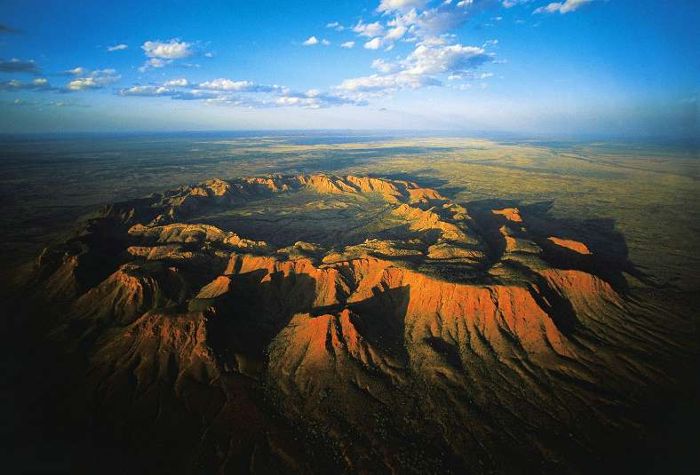
2. gosses bluff, northern territory, australia (google maps)

age - 142.5 million yrs
diameter - 5 km


around 142.5 million years ago gosses bluff crater was formed by an object thought to be around 600 metres in diameter. the crater you see today is actually a lot smaller than the original depression due to erosion. its diameter currently stands at 5km, the original diameter thought to have been closer to 20km.


3. vredefort crater, johannesburg, south africa (google maps)

age - 2 billion yrs
diameter - 300 km


with an astounding diameter of around 300km, vredefort basin in south africa is currently the largest confirmed impact crater on earth and also one of the oldest at 2 billion years. the crater was the result of an extreme impact with an object whose diameter was 10km.


4. manicouagan reservoir, quebec, canada (google maps)

age - 212 million yrs
diameter - 72 km


this incredible 72km wide impact crater in quebec has slowly transformed into its current state, what was originally the rim of the crater has since eroded away due to glaciation. the impact occured around 212 million years ago and the diameter of the asteroid is estimated to have been approximately 5km.

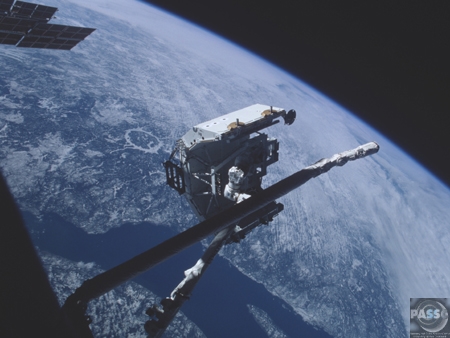
you can clearly see the reservoir in the amazing photo below, taken from the international space station during the sts-100 mission.


5. bosomtwe crater, lake bosomtwe, ghana (google maps)

age - 1.2 million yrs
diameter - 10.5 km


the actual impact crater which holds lake bosomtwe is 10.5km in diameter, the lake itself 7km. the impact took place 1 million years ago and since then, due to heavy rainfall, the water level has sometimes spilled over the rim and flooded surrounding areas.


sources: 1, 2, 3, 4, 5, 6, 7, 8, 9, 10, 11, 12

Vredefort Crater-The largest verified impact crater on Earth

Vredefort Dome*
UNESCO World Heritage Site

The  multi-ringed Vredefort crater
State Party  South Africa
Type Natural
Criteria viii
Reference 1162
Region** Africa
Inscription history
Inscription 2005  (29th Session)
* Name as inscribed on World Heritage List.
** Region as classified by UNESCO.
Vredefort crater is the largest verified impact crater on Earth. It is located in the Free State Province of South Africa and named after the town of Vredefort, which is situated near its centre. The site is also known as the Vredefort dome or Vredefort impact structure. In 2005, the Vredefort Dome was added to the list of UNESCO World Heritage Sites for its geologic interest.

The crater is occasionally known as the Vredefort Dome and the Vredefort Impact Structure. It is estimated that the asteroid that formed the crater was 10 km in diameter. The crater itself has a diameter of nearly 300 km. The crater is over 2 billion years old. Because of erosion it is hard to estimate the original depth and diameter of the crater.
The force of the impact that created the Vredefort crater was much higher than that of the Chicxulub crater. Imagine taking every nuclear bomb in the world and exploding them all at the same time. Now imagine an explosion at least ten times more powerful and you would have an idea of the force that created Vredefort crater. The projectile and much of the immediate target rock would have been vaporized and rocks that were further away would have been melted together. Remnants of this melt still occur in the form of large deposits of a special rock, known as Vredefort granophyre. It is very fortunate for evolution that there was nothing more than microscopic plant life at the time. If an impact event one third the size of this one (Chicxulub) killed off 75% of life on the planet, imagine what the Vredefort impactor would have done.
The Vredefort crater has provided shelter for man for at least 150,000 years. There is ample evidence of that. In Iron Age times, from about the 1300s to 1850, maybe as many as tens of thousands of Tswana people lived in the mountains and hills of the dome, likely because the varied landscape provided shelter and excellent grazing alike. In even more recent times, the area has seen a little gold rush.

Monochrome satellite view of the crater
The Vredefort crater is the largest verified impact event on Earth, but do not forget about Wilkes Land in Antarctica. It is thought to be much larger, but can not be verified at this time because it is buried under 2 km of ice. Vredefort will continue to play an important role in science for the remainder of this century and beyond as students visit the area to study it. As a method of insuring that, the site has been declared a World Heritage site.
There are many interesting articles on the internet about the Vredefort crater. There are a few more related articles here on Universe Today. and Astronomy Cast.

Asteroid Impact Craters on Earth

Asteroid impact craters are among the most interesting geological structures on any planet. Many other planets and moons in our solar system, including our own moon, are pock-marked with loads of craters. But because Earth has a protective atmosphere and is geologically active — with plate tectonics and volcanic eruptions, mostly relatively young oceanic crust, and harsh weathering from wind and water — impact structures don’t last long and can be tough to come by.
But on a few old pieces of continent, especially in arid deserts, the marks of asteroids have been preserved. One well-known example is our own Barringer crater, also known as Meteor Crater, in Arizona. The images here show some of the biggest, oldest and most interesting impact craters on the planet.

Aorounga crater, pictured above and below, is one of the best preserved impact craters on Earth, thanks in part to its location in the Sahara Desert in Chad. The 10 mile-wide crater is probably around 350 million years old. The stripes are alternating rock ridges and sand layers, known as yardangs, caused by persistent unidirectional wind. The image above was taken by astronauts in the International Space Station in July. In the radar image below, taken from the space shuttle in 1994, reveals that Aorounga may be one of two or three craters.

The Shoemaker crater in Western Australia, formerly known as the Teague crater, was renamed in honor of the planetary geologist Eugene Shoemaker for whom the Comet Shoemaker-Levy 9 is also named. The age of the crater unclear, but it could be 1.7 billion years old, which makes it the oldest known impact in Australia. The brightly colored splotches are seasonal salt-water lakes. This image was taken by the Landsat 7 satellite.

The Manicouagan Crater in northern Canada is one of the largest impact craters known on Earth. The impact occurred around 210 million years ago at the end of the Triassic period and may have caused a mass extinction that killed around 60 percent of all species. Though the crater has mostly eroded, Lake Manicouagan outlines what is left of the 43-mile wide impact structure. The asteroid that created the crater is thought to have been about three miles wide. Today the lake is a reservoir and popular salmon fishing location.

This crazy looking structure in Western Australia is called the Spider crater, for obvious reasons. Geologists determined it was an impact crater when they found shatter cones, telltale cone-shaped, grooved rocks found only around impacts. The crazy looking legs surrounding the impact are mostly due to erosion of different rock layers. The harder sandstone ridges withstood the weathering of wind and water better than the softer intervening layers. The crater is somewhere between 600 million and 900 million years old and the raised area at its center is around 1,600 feet wide.

The image above is a false-color image taken by the Advanced Spaceborne Thermal Emission and Reflection Radiometer on NASA’s Terra. The true-color image below was captured by Taiwan’s Formost-2 satellite

The Gosses Bluff crater in Australia’s Northern Territory sits between two mountain ranges. The raised circular feature in the center of the structure is around 2.8 miles across, but the original crater rim was probably at the edge of the surrounding grayish area. The crater was formed caused by an asteroid impact around 140 million years ago.

Clearwater Lakes in Quebec, Canada were formed by a pair of asteroid impact craters. The impacts probably occurred simultaneously around 290 million years ago. The larger crater measures 22 miles across.

The Roter Kamm crater in Namibia is hard to see in visible light, but shows up more clearly with imaging radar. The crater’s 1.5 mile-wide rim stands out as a bright ring in the lower left of the image, which was taken by a radar instrument on board the space shuttle. Irregular surfaces show up brightly and smooth areas are dark. The white splotch at the bottom of the photo is a rocky hill, the darkest areas are wind-blown sand dunes, the blue around the crater’s rim may be material that was ejected during the impact, the red is limestone outcrop and the green areas are mostly vegetation. The impact occurred around 5 million years ago.

 
Support : Venus Net | Pagak City
Copyright © 2013. pornstar galery Milf - All Rights Reserved
Template Created by Together Published by Venus Net
Proudly powered by Blogger